
Encapsulation
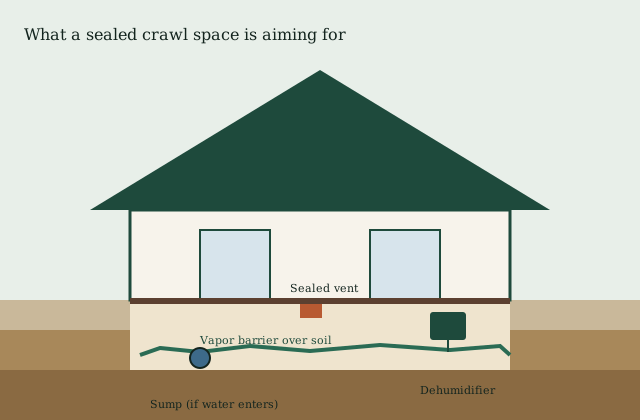
A sealed system: liner on the soil and walls, closed vents, and humidity control when the space needs it.
Encapsulation explainedHuntsville · Madison · The Tennessee Valley
If the house smells musty, the floors bounce, or the dirt under the home stays damp, the crawl space is usually part of the story. We help you request an inspection with an independent local specialist — and we explain the work in plain language first.
North Alabama Crawl Space is a referral service. We are not a licensed contractor and we do not perform crawl space work ourselves. When you request an inspection, we share your information with an independent local specialist who serves the Huntsville area so they can contact you, inspect the space, and provide their own quote.
Three steps, with no pressure to buy a system before anyone has been under the house.
A smell on the first floor, water after rain, sagging floors, or just a desire to know what is under a house you are buying or already live in.
Your request goes to an independent contractor who works in the Huntsville area. They call you to set a time to look at the crawl space.
You should leave with photos or a clear explanation, a recommended scope, and a price you can compare. You decide whether to proceed.
North Alabama sits in a humid subtropical climate. Summers are long, the air holds a lot of moisture, and rainfall is generous across the year. A vented crawl space was once treated as the default: open the foundation vents, let the space “breathe,” and assume the ground under the house would stay out of the way. In this climate that assumption often fails.
Outside air that is both warm and wet does not dry a cool crawl space. It often condenses on floor joists, ducts, and pipes. At the same time, bare soil under the house releases water vapor upward, day after day. The house itself behaves a bit like a chimney: air leaves through the upper levels and replacement air is pulled from the lowest opening it can find. On many ranch and split-level homes around Huntsville, that opening is the crawl space.
The soils add a second problem. Much of Madison, Limestone, and Morgan counties is residual clay over limestone. Clay holds water and changes volume as it wets and dries. The limestone beneath it is karst terrain, which means water can move through joints and solution openings rather than soaking in evenly. A crawl space can be dry on one visit and hold water after the next long rain, especially where downspouts dump beside the foundation or the lot was graded to a neighboring slope.
None of that means every house needs a full encapsulation. It does mean an inspection should separate three different issues: vapor rising from the soil, humid air coming in through vents, and liquid water arriving after storms. Those problems have different fixes. Sealing a crawl space that still takes on water is a lid on a puddle, not a repair.
The specialist you are referred to should recommend only the work the inspection supports.
A sealed system: liner on the soil and walls, closed vents, and humidity control when the space needs it.
Encapsulation explainedSistering joists, adding or replacing supports, and fixing damage after long moisture exposure.
Repair guideInterior drains, sump pumps, and exterior grading so liquid water has somewhere else to go.
Drainage and sump pumpsWhen a properly installed liner is enough — and when a torn builder-grade sheet is not.
Vapor barrier basicsHow a crawl space unit is sized, where the condensate goes, and why it is not a substitute for drainage.
Dehumidifier guideWhat staining on joists usually means, what an inspection should check, and what this site cannot diagnose.
Moisture and moldEach area page describes local housing and ground conditions — not a copied paragraph with the city name swapped in.
Valley floors, older ranches, and newer subdivisions built on graded lots.
Fast-growing neighborhoods and a lot of 1990s–2010s crawl space construction.
Foothill lots, drainage from higher ground, and mixed crawl and basement homes.
Newer subdivisions on former farmland, often with builder-grade soil covers.
A county-seat mix of older streets and newer growth toward Huntsville.
River city humidity, older neighborhoods, and a wide mix of foundation types.
Someone needs to go under the house. A quote given from the driveway is a guess. A careful look usually covers:
Ask for the findings in writing, including what is recommended and what can wait. If two companies quote very different prices, compare the specification — liner thickness and how it is fastened, whether vents are closed, whether a dehumidifier is included, and whether water management is part of the job or excluded.
No. We are a referral service. An independent local specialist does the inspection and any work you hire them to do.
Angi and HomeAdvisor’s 2026 national guides put a typical project around $5,500, with most work between $5,000 and $15,000. Local prices vary. Read the cost guide.
Many specialists in this market inspect at no charge. Confirm that when they call, and confirm you are not obligated to buy work by scheduling a visit.
Request an inspection and we will connect you with an independent local specialist who serves Huntsville and nearby North Alabama communities.
North Alabama Crawl Space is a referral service. We are not a licensed contractor and we do not perform crawl space work ourselves. When you request an inspection, we share your information with an independent local specialist who serves the Huntsville area so they can contact you, inspect the space, and provide their own quote.